Tuesday, August 23, 2005

Seasons for All Things


In Isan the joke is, "Our seasons are simple: we have hot, hotter, and hottest."


But actually, we do have three very distinct seasons mixed in with the heat. [Following references to temperature are in Fahrenheit.]

NOVEMBER, DECEMBER, JANUARY

"WINTER"

Lower humidity (60-70%), 80 degrees in the afternoon, but gets down to a frigid 60-70 degrees at night. Believe it or not, it feels VERY cold at those temperatures. People walk around in big winter coats, neck scarves, knitted caps, and ear muffs! At first it was funny. I sported my short-sleeved shirts the first year while my students looked like Santa's elves bundled up against the cold of the North Pole.

Well, 2-1/2 years later, I now wear my old ski coats I dragged along with me from Washington State.

These "cold" temperatures are unique to Isan, as nothing blocks the cold winds that sweep down from China. Bangkok, central, and south Thailand remain pretty warm (80's-90's day and night). The staple of life, rice, ripens in November-December and is harvested at that time.


FEBRUARY

Transition to Next Season


MARCH, APRIL, MAY

SUMMER

(Yep, right. No spring)

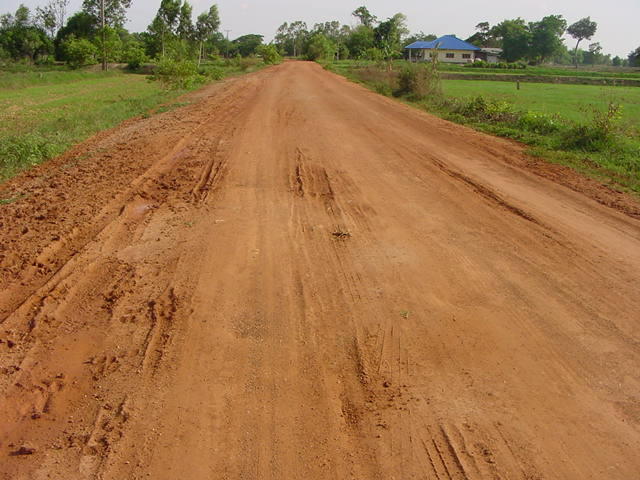
Extremely hot (105-110) and humid (90% and higher), no rain. Despite the humidity, the land still dries out. Everything dry as a bone, and everything dies but the trees. Villages run out of water, and children scrounge for little crabs, frogs, lizards and eels to eat at the bottom of dry cracks in the hard soil. It's a very harsh time when nature seems bent on crushing all the life out of the land and its inhabitants.

This extreme heat is also unique to Isan. I lived a couple summers in Red Bluff, California (where it hit a record 124-degrees my second summer), so I was psychologically prepared for it. But not the humidity!

JUNE

Transition to Next Season


JULY, AUGUST, SEPTEMBER

RAINY SEASON

Monsoons

Temperatures moderate to 80-'s and 90's. Everything very suddenly turns verdant green, the rice fields look like golf courses (tall grass!), and the water buffalos smile. Many tree fruits ripen at this time. This is the main rice-growing season, and the harvest comes next season.

All of Asia (from India to China and Japan) experiences these monsoons. Japan gets the added "perk" of typhoons at this time.


OCTOBER

Transition to Next Season


**************

It's a very different seasonal cycle from that which I was used to in any place I've lived in the USA (Washington, California, Michigan). What's fun to observe is how everything seems to be more closely tied to the seasons and the land, here. Almost every holiday is seasonally-related, or agriculturally-related; usually dealing with praying for future rain, thanking nature for current rain, or the activity of harvest time.

**************

SIDEBAR: Another interesting sidelight is that, this close to the equator, the days and nights are equal (12 hours each) year around. The sun consistently sets at 6 and rises at 6. It affects my sleeping habits. I sleep about 2 hours more a night here than I did in the USA. And, unlike being close to big population centers (as in the Seattle area), it gets DARK when the sun sets on moonless nights. When the electricity goes out (as it frequently does), you can't see your hand in front of your face. It's weird. One little birthday-cake candle throws an amazing amount of light in that situation!

It gives new visual images to the child’s song “This Little Light of Mine.”

Friday, August 05, 2005

To Taste Thailand


News Item: August 4, 2005

A new Pizza Hut promotion in Thailand--a pizza with four sections. One of the sections is covered with strawberries. (In picture, upper left quadrant).

***************************

Strawberry pizza? Hardly a surprise in Thailand. Cases in point:

A favorite way to sell vanilla ice cream is two scoops stuffed into a hotdog bun--with corn kernels sprinkled on top. In fact, corn shows up in a multitude of culinary delights: Warm corn drink (like drinking creamed corn, only much more watery), mixed corn and ice swimming in condensed milk for dessert, corn on bakery pastries, etc.

Half the pastry in bakeries is stuffed with shredded, sweetened pork. It feels like shredded coconut in your mouth, but definitely tastes like pork!

All the 4 and 5-star hotels in Thailand advertise "American Breakfast!" What does it include? A steamed frankfurter, a shredded cabbage salad, and sliced tomatoes with cucumbers. Never saw that at the local USA diner, mixed among my pancakes!

A "hamburger" at the local Seven-Eleven actually consists of a piece of chicken stuffed in a small hamburger bun, with familiar condiments.

Nearly all the favorite "crunchy" snacks found at the convenience store come in the following flavors: squid, fish, and shrimp. All smell very foul when you open the package--something like a fishing boat that needs a good mucking out.

And the favorite food of Northeast Thailand? Shredded pappaya salad, drenched in fermented fish paste. More of the fishing boat aura.

Then there's the favorite fruit, durian. The taste is palatable, but keep your nose plugged. It smells like a well-used cat litter box. I liked it until one of my friends made the cat box comparison.

And of course, most cooked animals come with their heads and feet on the platter as well, particularly fowl. I side with one of my skitterish US friends: "I try not to eat anything that's smiling at me."

The folk wisdom in Isan affirms: "If it moves, eat it." Favorites on the farm menu are frogs, eels, scorpians, lizards (large and small), and nearly every insect that flies, crawls and burrows. Roasted silk worms are a real hit: chomping through a crispy, roasted exterior, one is surprised at the creamy, almost custard-like interior. Very nourishing. Very filling. In fact, so filling that at my first try, it only took one to send me to the restroom to reduce the load on my stomach and psyche. Now I can eat two or three at a sitting without unexpected bodily reaction.

Acquired tastes? Yes, some things do grow on you. After a couple years, I've come to really develop a penchant for:

1. Yogurt milks
2. Hot, hot chili peppers
3. Lemon grass
4. Roasted garlic cloves
5. All soybean and rice drinks
6. The exotic fruits of rambutaan, mangosteen, dragon's eyes, and a couple other fruits without English names and that defy description as well.
7. Yup, and corn on my ice cream.

If it moves, eat it.

Wednesday, August 03, 2005

Ghosts

Nearly every Thai is a firm believer in ghosts. After living here two-and-a-half years, I've heard a hundred ghost stories. These are not the tongue-in-cheek-let's-spin-a-good-yarn-by-the-campfire sort of ghost story. These are hushed first-hand accounts from firm believers whose story ends with some sort of misfortune caused by an evil spirit. Ancient spiritism and animism is alive and well in Thailand--even on a modern 21st century university campus graced with a radio station, computer labs, a modern engineering building, and all the other trappings of modernity.

One of my students had a near-fatal motorcycle accident two years ago late at night. He had just driven by a dark temple compound, which is sometimes feared like graveyards are in the west. Temples are where bodies are burned and ashes are buried into crypts in the compound walls; so spirits are thought to linger about the area. My student friend tells me that just after he passed the temple compound, someone glancing his way saw a lady dressed in white sitting behind him on the motobike. The apparition matched the description of a "Pob" ghost--a strikingly beautiful lady who glides about in a mysterious long white dress. However, she is only a "head." Inside the dress are only bare internal organs, not enclosed by a body. She's considered to be a very dangerous and malevolent spirit. Hence, the explanation for his accident. (By the way, at 80 miles per hour, and drunk, he hit a dead dog lying in the road, which sent him out of control. Another possible explanation for the accident.)
A few months ago, one of our younger professors who just won a Fullbright Scholarship to study in the USA for three years, came into my office late at night, as he was preparing to leave.

"Staying late tonight?" he asked with obvious consternation.

"Of course, probably until about 11pm or midnight. Why?"

"Aren't you afraid to stay by yourself?"

"Not really. Should I be?" I thought maybe he knew of some prowling murderer loose on campus.

"What about ghosts?"

I was taken aback. I didn't really expect that comment from someone who had just gotten his master's degree from one of Bangkok's more progressive universities. But my teacher-friend was Isan to the core, which included a solid belief in malevalent spirits--which especially like to plague people who remain alone in big empty buildings.

His wide eyes and sincere concern actually rattled me just a bit.

So that same night, after shutting out all the lights, and powering down the noisy air conditioners, things seemed unnervingly quiet. Then, wandering through a cavernous dark room to the distant door on the far wall, I was just a little more alert to strange sounds and fleeting shadows. What is that white thing in the far corner? A lady in white? No, just the faculty refrigerator in the pantry area.

Never afraid of ghosts in my life, and now I start this in my mid-50's? Get a grip!

A
lmost every night you can count on the TV to dramatize one or two ghost stories in a thriller. Although it scares them, the Thai cannot help watching these, the way morbid onlookers are drawn to the scene of an accident. Every Thai child is told the story of Nang Nak (you can read a brief description of it at www.thailandlife.com/nangnak01.html )

The Thai have many categories and types of ghosts and every Thai person knows all the "species" by name. Thus, I share with you a great article which spells it out in ghoulish detail. I'm gradually learning these names, because it's so much a part of daily conversation!

Picture from a book on Thai ghost stories.


***************************

A Guide To Thailand's Ghosts and Spirits


The Thai spirit world is populated by a plethora of ghosts, ghouls and demons - some good, some harmful, and some openly dangerous. Among the most interesting are:

Phi Peta - A hungry ghost. Everyone who is preoccupied with material attachments to the exclusion of the spiritual will be reborn as a Peta, having a giant belly and an mouth as small as the eye of a needle. Peta may sometimes be heard whistling at night, looking for people to make merit for them. This ghost is relatively harmless.

Phi Am - A ghost which sits on the chest or liver of sleepers, causing discomfort. It can be harmful.

Phi Chamob - A ghost which haunts the place where a woman has died in the jungle. This spirit does not do any harm.

Phi Ha - The spirit of a woman who has died in childbirth. This ghost is considered to be very violent.

Phi Krahang - This ghost appears as a man with feathers and a tail like a bird. It eats filth and glows at night. An unpleasant and frightening spirit.

Phi Krasy - This ghost lives inside a witch and leaves her body during sleep by way of the mouth. The Krasy is the colour of fire, has a head the size of an electric light bulb and a half-metre long bluish tail. A Krasy ghost likes dirt and does not generally harm human beings, although when it consumes entrails (hardly surprisingly) it can cause death. Krasy witches have a sleepy appearance during the day. Their eyes don't blink and they can never look anybody in the face. Also, they don't cast any reflection in the mirror. Before Krasy witches can die, they have to find somebody who will inherit the Krasy by consuming some of the old witch's spittle.

Phi Lok - A ghost which haunts various localities. It frightens and misleads people, and can be seen as well as felt.

Phi Phrai - The spirit of a woman who has died in childbirth and whose body has been used to make phi thai hong lotion. A sorcerer must hold a candle under the corpse's chin, and from the resultant melted oil essences are manufactured which drive men mad and attract women.

Phi Tai Ha - The spirit of a woman who has died of malaria. The ghost will also spread this disease.

Phi Thuk Khun - The substance of a living person which has to be sent out on astral journeys every week, or harm will come to its owner,

Phi Khamod - A spirit in the shape of a red star which, like a Will o' the Wisp, misleads wanderers.

Phi Nang Tani - A female tree spirit which is essentially beneficent and may fill the alms bowls of itinerant monks.

Phi Pa - A forest spirit. Hunters may leave a piece of the foot, lip, tongue or eyelid of a killed animal to show respect to this spirit.

Phi Poang Khang - A spirit in the shape of a black monkey which likes to suck the big toe of people sleeping in the jungle. It is said to live near salt licks.

Phi Ka - These spirits are inherited through women and can be contagious. The Ka, if not properly treated (with raw eggs) will attack and possibly possess people without the owner's knowledge. Perhaps understandably, ordinary people are said to be reluctant to marry into Ka clans!

Phi Hai - Hungry, amoral spirits associated with places where people have died an unnatural or violent death. Phi Hai are easily offended, and take every opportunity to possess people. Normally, they can be induced to leave their victim if suitable offerings are made, but on occasions an exorcist has to drive them out. In such cases, when incantations and lustral water prove insufficient, a whip may need to be employed.

Phi Pob - A malicious and very dangerous spirit which manifests itself as a beautiful woman. Phi Pob float through the air because they have no legs or lower body. They generally appear as a length of internal organs and intestines suspended from a strikingly lovely face - therefore, beware beautiful women gliding mysteriously by in long dresses! This type of ghost is probably more feared than any other species in Thailand.

C
learly, there can be no doubt that belief in ghosts and spirits remains widespread throughout Thailand....Chinese "bouncing" ghosts have long been a staple of Thai television and children's fantasy. Muslim ghosts have appeared which can be driven off by flourishing a piece of pork (preferably a pig's head) at them, and even vampires have made the long journey from Transylvania to Thailand. In this age of mass communication and international tourism, ghosts too - or so it would seem - have become world travellers!

Text of above article, copyright © Andrew Forbes / CPA 2003. Found at www.cpamedia.com.
Saturday, July 16, 2005

Not Surviving, But Thriving

To the Editor, The Seattle Times, 16 July :


Taking responsibility

Wow! It looks like Thursday's edition of The Times should have been called "The health-care edition." I read everything, the front-page article on the health-care-cost study and all three columns on the editorial pages. What I found to be conspicuously absent is Americans' abject failure to take responsibility for their own health. I'm certainly no expert in the field, but living in Europe and traveling extensively have given me the opportunity to compare how we live to those in other nations.

I can only conclude that our poor diets and sedentary, TV-watching, car-based, drive-through lifestyles have a far larger impact on our national health than anyone is willing to admit. Combine that with the American penchant to seek the easy way out with cure-all drugs while scapegoating segments of the population like smokers (more Europeans than Americans smoke, yet their overall health is much better).

While I can't argue that it's not vitally important to continue working on finding the best and most effective diagnostic and treatment methods to help those in need, I can't help but wonder how many people could avoid...hypertension meds entirely by simply putting the Big Mac down, shutting off the TV for an hour and going for a walk every day. A healthful lifestyle is more difficult and time-consuming than popping a pill, but we'll all have less to complain about and less to pay for by addressing the root of the problem rather than just treating the symptoms.

— Sean Conner, Seattle


My Two Cents

As I read the above article in today's on-line edition of the Times, a slow smile spread across my face when I realized I have somehow been hoodwinked into a healthier lifestyle just by moving to Thailand.

The first indication was the 15 pounds that magically melted away within the first three months of arriving. There are several likely reasons for this, which really don't take a rocket scientist to deduce...

For example, most of the time the elevators don't work in our eight-story building. When they do, they are unbearably stuffy with 15 bodies crammed against each other for the two to three minute snail's pace ride in non-airconditioned discomfort. So, two to three times a day I huff and puff my way up six and seven flights of stairs to my classes on the sixth and seventh floors (with 40 pounds of computer equipment, LCD projector, textbooks, and papers). I carry a loaded book bag on my back, and a heavy shoulder bag of electronics. What really puts the smile on my face, is passing up most of the students on the stairs. As I brush past them I hear "OY!"--an exclamation that means many things. In this case, probably, "There goes that mad foreigner again!" Enjoy it while I can. At 70 if I don't mention this experience, don't ask.

I walk at least a mile a day just to get around the campus. Everytime I catch a bus to the nearest large city, it's a one mile trek to the nearest bus stop. Inconvenient? You just build it into your schedule, and take something to shield yourself from the sun (hat, newspaper, umbrella, etc.). Add to this my daily one-hour workout at the university's well-equipped fitness center, and I do believe I'll live on for another week or so.

Due to the weather, and my physical activity, I sweat three or four litres (about a gallon) every single day. It's not unusual to have my clothes soaked completely, as if I had been caught in a rainstorm. Last Tuesday, I had four showers, and four changes of clothes. It is said that sweat is one of the best ways to rid the body of toxins. Well, my toxins must be heavy commuters--in and out in a flash! To compensate, I have to take in at least a gallon of water a day as well. Fortunately, bottled water is pure and cheap at about 24-cents a gallon.

Olfactory side note: Fortunately, the different type of deodorants available here are effective. In disgust, I finally had to throw away the four or five Mennen Deodorant sticks I brought from the USA--they just couldn't cut it. So, here, if you use Thai-brand deodorants, you can sweat profusely but not stink. The Thai are very fastidious about personal cleanliness as well. It's very rare you catch the whiff of anyone's body odor, despite a tropical climate, crowded elevators, and standing-room-only public buses. Furthermore, a Thai bathes at least two and sometimes three times a day.

Try as I may, I can hardly find mega-fattening, inexpensive stuff to eat. If I do, it's outrageously expensive. Snicker's candy bars are the same price as a full meal in a restaurant; about 40-50 cents. The REAL downside: they're about half the size of USA Snicker's bars, with half the sugar. Bummer. The ice cream is scrumptious, but one cone is also the price of a full meal--definitely a pricey luxury.

Probably the strongest indicator of better health is that my stress level is noticably WAY down from several years ago. Ringing ears is a thing of the past. I haven't had a stress-related headache or backache in over a year (I had them at least a couple times a month back in the USA). I believe the biggest reason is the "mai pen rai" society--"chill out", "take it easy", "don't let anything fluster you"--mentality. Another reason is the really very warm and sweet people I deal with every day. The Thai are truly gentle folk. Raising one's voice is a real no-no in this society. If you do, your level of respect drops about 50% or more. Any problem or crisis seems almost immediately diffused by a gentle Thai response. Even sticky or emotional negotations are carried out with a smile and soft voice.

In April, while vacationing in Chiang Mai, I witnessed a motorcycle collision between two teen drivers who were carrying teen passengers as well. One party was very definitely in the wrong. From a small side road, they pulled right into the path of the other motorcycle going down a main highway. A terrific impact with flying debris, and both parties spilled to the hard pavement. Both endured significant damage to the cycles, and the teens were mostly bruised and skinned up. I anticipated watching my first street fight in Thailand. On the contrary, not one word was said. Both parties, with a big smile (mostly from embarassment) picked up themselves and their damaged cycles, and walked off, pushing their mangled steeds in their respective directions. That was it. No, "What in the world were you trying to do???!!" or "Are you blind?" or "Call the police!" or "You're gonna pay for this!." Just a sheepish smile and a quiet parting. Amazing Thailand.

Undoubtedly, another reason for having such a low stress level in a foreign culture, is a sense of "belonging." I feel very highly valued by my friends, with most of them like family. I can walk into the homes or apartments of any these folks and feel at home. Even the American family I socialize with (the Baptist missionaries from Tennessee) smoothly fit right into the culture here, and they're so relaxing to be around. In addition, the students go out of their way to show the highest respect and honor to teachers, imparting that "valued" feel. They carry your books, bring your lunch, and I've even seen them washing teachers' cars and motorcycles.

Even total strangers are gregarious and welcoming. Today, I planted a little tree in the front of my duplex. A middle aged man I had never seen before (visiting my neighbor) walked over and got down on his hands and knees with me, assisting with the operation. With newly dirty pants and mud under the finger nails, he left with a big smile on his face. The tree was a gift from another neighbor down the road I only met today. I tried to pay her for it, but she would have none of it. All this kindness, from complete strangers--a soothing balm to an expat soul.

Granted, the Thai are not perfect, and certainly there are negative aspects of their culture as with any other culture. However, they've got the stress thing licked. The only Thai I know who are stressed out are those who've been educated in the west and try to bring the high-stress, high-power, high-roller lifestyle back to Thailand. They go nearly mad because they can't get everyone else into their own overdrive gear. They end up becoming abusive or leaving Thailand for good to start a Thai restaurant somewhere. It's hard to go it alone, when no one else senses the "urgency" that you do.

Despite the more dangerous traffic (rules are for breaking), the increased possibility of infection (communal-style eating and drinking), and the not-quite-UL-approved infrastructure (no electrical grounding in homes and schools, manhole covers that flip up when stepped on, etc.), I believe I've added at least a decade to my life. According to many health experts, stress is the biggest killer of middle-aged and older westerners, resulting in heart problems, digestive disorders, hypertension, stroke, and a myriad of other ailments.

At least if I disappear into a Thai manhole someday, it shouldn't raise my blood pressure. Too much.

And the adventure goes on . . .
JD in Thailand


Thursday, June 30, 2005

Let Sleeping Serpents Lie

An old joke describes a New Yorker proudly presenting the awesome, roaring Niagara Falls to a visiting Texan. The Texan, starting with a chuckle, soon was into a full-bellied guffaw.

"What's so funny?" demanded the indignant New Yorker.

"Well looky here!" drawled the Southerner, "We got a plumber down in Texas that'd fix this leak in five minutes!"

So goes a number of "Texan" jokes that poke fun at the stereotypical Texan who thinks everything is bigger or better in the Lone Star State.

When it comes to the flora and fauna of Thailand, I'm beginning to feel like the Texan. The lush, prolific, and gigantic representations of the animal and plant kingdoms here continue to leave me awestruck. Some of our flowering trees look like 100-ft bouquets straight from the florist. Some of these wild orchids would be just too big to pin to your mom's Sunday morning outfit for Mother's Day. The dragon flies should be honored as a special division of the Royal Thai Airforce. And, you really haven't jumped high until you've felt a one-inch-long red ant scurrying across your bare foot. Among the flowers, green leafy plants, insects, and reptiles which all come Super-Sized, there's the bigger-than-normal-life aquatic creatures.

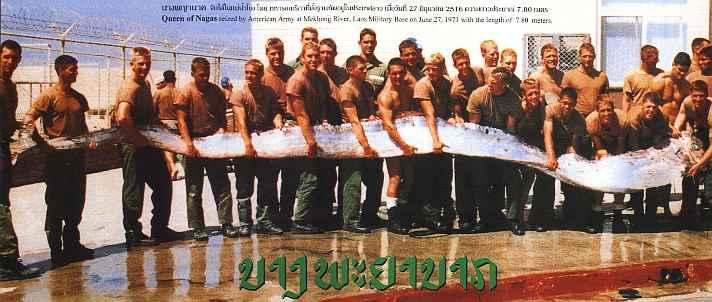
When I first visited the Mekhong River, bordering Thailand and Laos, I chuckled at what I assumed was a doctored picture of a "sea serpent" caught in the river by US Marines several decades ago during the Vietnam War. The picture hangs on many a souvenir shop wall at open air markets along the Mekhong.


However, in the last couple years I've been coming across more stories and news reports about truly mammoth creatures that inhabit these waters. Last week, Time-Asia magazine had a startling picture of a captured alligator which dwarfed a pickup truck over which it was draped, bound and snout-taped. The 30-ft (10-meter) 'gator looked like something out of a horror flick. Prior to its capture, it had eaten 27 hapless human beings over the years! Then there's the Mekhong catfish. Now there's nothing uglier than a wide-mouthed, beady-eyed, whiskered catfish, no matter where he hails from. But there's something REALLY ugly about one that is big enough to eat you. Hence, today's story from on-line Associated Press . . .


**********************

Thursday June 30, 7:18 PM (AP)

Thai fishermen catch world's largest freshwater fish

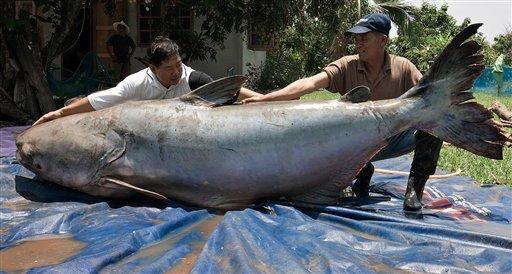
Thai fishermen caught a 293-kilogram (646-pound) catfish believed to have been the world's largest freshwater fish ever recorded, a researcher said Thursday.

The 2.7 meter- (8.9 feet) Mekong giant catfish was netted May 1 by villagers in Chiang Khong, a remote district in northern Thailand, and weighed by Thai fisheries department officials, said Zeb Hogan, who leads an international project to locate and study the world's largest freshwater fish species.

He confirmed it was the heaviest recorded fish since Thailand started keeping records in 1981.

"This is the largest individual fish of the species that's listed as the biggest in the Guinness Book of World Records," he told The Associated Press by telephone.

The fishermen had hoped to sell the fish to environmental groups, which planned to release it to spawn upriver, but it died before it could be handed over, and was later chopped up and sold in pieces to villagers to be eaten.

*****************

The surrounding exotic wildlife plays with my imagination, as well.

The grass on the little plot of land next to my duplex is reaching for the sky due to two factors: rainy season and my disinclination to break into a sweat trying to remove it. It took only a month to go from shoe-height to chest-deep. As I glanced out at the patch through my kitchen window last week, I caught an ominous sight. It was just on the edge of the grass jungle. Near the top of a tall tuft of grass I saw an unmistakable serpent's mouth slowly opening and closing--like he was sort of yawning. It was a big, ugly, dark mouth. I thought I could see flashes of red which must have been that evil darting forked tongue. Horrified, I tried to determine if it had a hood behind its head. I was remembering that Isan has the world's largest concentration of hooded King Cobras. Hypnotically, the yawning mouth pivoted back and forth, slowly opening and closing. It was almost like he was trying to taste the air, to see which direction live prey might be. I shuddered, despite watching behind my iron-barred, mosquito-screened window.

Then, before my disbelieving eyes, the dreaded mouth and head made a full 360-degree pivot (a la "The Exorcist"). Incongruously, it then disconnected from the neck, and gently fluttered away on the tropical breeze wafting through my weed-patch. It was only when the "serpent mouth" was in full flight did I realize I had been watching a rather large black and red butterfly sunning itself on my weeds. While stationary, the slow flexing of its wings had me convinced I was watching a loathesome snake-head on the lookout. Oh my, time to see a shrink.

With the recent reports from the Mekhong, now I've got something else to worry about. Over the last two years I've had occasion to go down to the water's edge at this mighty river, a couple of times dipping my fingers or toes into the warm muddy current. Now, my news and picture-poisoned imagination makes me think twice before doing so. That second thought advises, "Why not just let those behemoths live in peace, undisturbed?"

Or, like those Thai villagers, I will opt to meet my catfish in a skillet. Thank you.

Sunday, May 01, 2005

Staying Out of Black Holes

Er, may I pass?


All in a day's motorcycle ride . . .

Although elephant sightings downtown are commonplace here, I'll never forget the first time--that weird feeling--of coming upon an elephant in darkness on the outskirts of town while riding my motorbike.

Southeast Asian towns are quite dimly lit, so there's not enough general light to illuminate BIG things like elephants, trucks without headlights, a bulldozer parked overnight, a stack of hay that fell off a cart, etc. (all common highway hazards here). Further, your little motorbike headlights typically illuminate only about 30 feet in front of you, so you do come upon things quite quickly in the darkness here.

So what do you see when you come upon an elelphant at night? It won't be a gigantic semi-illuminated body in the road. All you'll see will be a black hole. You begin to gradually notice that the dim lights of town ahead have a strange, big, mysterious black hole. It just doesn't compute. As you get closer, the hole gets bigger--and sometimes starts moving. It's enough to make you question your sanity. Only when you nearly are under its legs do you realize you've come upon an elephant taking up half the roadway.

Further, elephants have a pesky tendency to panic and rampage all over anyone or anything that startles them. A normal-sized adult elephant can pretty much stomp the livin' daylights out of a Toyota pickup, not to mention my little Honda motorbike. I've been lucky enough to make last-ditch maneuvers to avoid those close encounters of the large kind. Others haven't been as fortunate as I. Their epitaphs read something like "Overcome by a Black Hole", or "Left This Life as a Pancake." Not my vision of how I want to check out...

Fortunately, the highway division of Thailand has thought of everything. I recently came upon an official notice in the newspaper for drivers, and thanks to the translation help from a friend, I share it with you. So just in case you are suddenly confronted with an elephant on I-405, here's some motorist tips which will certainly come in handy:

***************************************************

  1. Try to avoid the freeway which borders the nearby national park between 7pm and daylight, especially where there are elephant warning signs.
  2. Elephants can effectively block the road in a number of ways--standing in the middle, walking along the road or feeding on roadside vegetation. In all of these cases, cars should not try to pass them.
  3. If you see an elephant blocking the road, stop your vehicle, then...

    • First check that there are no other elephants to the side of you or behind you. If there are, stay still. Usually the elephants will be moving together. Let the elephants next to you, or behind, walk past you and join their friends.
    • Do not turn off your engine or your lights at night. If you do, you cannot see where the elephants are and turning your engine back on again may scare the elephants causing them to panic and maybe attack the vehicle.
    • Keep your distance from the elephants, at least 20 meters (60 feet).
    • If there are vehicles in front of you, closer to the elephants, give them space to maneuver. If the elephants move towards them, they may need to reverse in a hurry. If the vehicles are too close an accident may occur!
    • If the elephants walk towards you, slowly reverse and keep your distance, until the elephants leave the road. When they do, you can drive on.
    • If the elephants walk away from you, perhaps going out of sight round a corner, follow them slowly. Again keep your distance until they leave the road and you can pass by.


  • Last but not the least, all motorists should check with traffic police once in a while to see whether elephants have been seen recently.
*************************************

There you go. Don't say you weren't warned.