Tuesday, October 11, 2005

Livin' It Up On a Shoestring


Living in Central Isan, I cannot possibly spend all of my meager teacher's salary in one month! Here's my monthly expense breakdown in Thai baht. This supports two people minimum, although I’m often treating more than one friend at mealtimes. (U.S. dollar equivalent in parentheses.)

Spacious, new, clean duplex apartment: 2500 ($60)
Utilities (water/electric--including air con): 1200 ($30)
(that's on a hot-weather month)
Phone, including high-speed internet service: 750 ($20)
Food (three daily meals in restaurants): 3000 ($75)
Clothes: 500 ($12)
Toiletries: 250 ($6)
Household supplies: 500 ($12)
Motorcycle gasoline/petrol: 200 ($5)


When I first moved here, it cost me about $1000 USD to completely furnish an apartment: TV, clothes washer, stove, refrigerator, beds, desks, sofa, two floor oscillating fans, wardrobes, kitchen sink and counter (yup!), and three floor-to-ceiling wood bookshelf/cabinet units. All new.

Another $1000 USD bought my transportation (a new 125cc Honda motorbike), and I was set!

If one thinks about living in Bangkok (BKK) costs are many times the above. A BKK friend rents an apartment about one-third the space of mine on a 9th floor for a whoppin’ 6000 baht. From there, it's an inconvenient one-hour bus commute to his job in the central city. Monthly rent 10,000 baht and upward for an equivalent apartment to mine is the norm.

However, even better than BKK, here the air is clean, the water is purer, the horizon more spacious, people smile more, and no traffic jams. Rural living is very peaceful and laid back. (That might drive some foreigners crazy, I admit). BKK is an overnight bus ride away when you get lonely for the big city lights. Two nearby airports make it even quicker: a 45-minute flight for about $40 USD, Thai Airlines. ($20 discount airlines).

But please-- don't tell anyone else about how good it is here. We don't want it to get too crowded!

Monday, October 10, 2005

Thai Names, Tongue Purgatory


Did you take phonetics in primary school? It finally paid off for me in my old age when I have one foot in the grave and another on a banana peel. My first day of teaching in Thailand, May 3, 2003, I faced the daunting task of deciphering the class list.

Unmercifully, it was in Thai script.

Mercifully, I passed around the list and the students transliterated their names into English script.

Unmercifully, I was no better off.

When the list came back to me, I faced the most confusing combination of vowels and consonants I'd ever laid eyes on. It must be a cruel joke. No one has a name this long. Up until that point, I thought "supercalifragilisticexpialadocious" was The King Tongue-Twister. Well, I hadn't been to Thailand yet. I stared at the list. The drops of perspiration belied my faked calm. My students had that "Now watcha gonna do?" smirk.

Hope you finally learn one difficult last name, and at least there will be a few repeats? (Like Smith, Jones, Wilson in the USA?) Dream on. Nearly every last name in my classes is unique, unless more than one student is from the same village (rare). In many villages many, and sometimes, the majority of the inhabitants have the same last name, which identifies their geographic origins. (Imagine every couple in a little Washington State town having the same name: "Mr. and Mrs. Duvall", or "Mr. and Mrs. Moses Lake").

Fortunately, the Thai like to go by their first names in conversation, and there are repeats. Still, three-syllable first names abound, so I had a BETTER idea--ah, the NICKNAME!

Thank God, most Thai also go by a one-syllable nickname (and they are sometimes very strange: Beer, Golf, Dung, Wit, Nit, Cat, Rat, Pooh, etc.). One syllable, even if it's a bit strange? I can handle that! Ah, pitffall ahead! Read on...

So after staring at my English-script class list until the students thought I'd turned into stone, I sent it around again. I cleverly had the students add their nicknames to their never-ending real names, and knew I’d licked the problem. I was now smirking.

Nope. False victory.

Now, with their "simple" one-syllable nicknames, I had to master the tones and dipthongs (vowel combinations). At least one girl in every class had the nickname “Koy”. OK, so I said it like it looked. Every day at roll call, my classes erupted into gales of laughter at my "Koy", and none of my mischievous little darlings would divulge the reason. Somehow they wanted me to keep this up. Normally, they talked and laughed with each other during the calling of their other nicknames, but when I came to Miss Koy, they hushed, edging forward in their seats, in eager anticipation of hearing the Farang Teacher botch her name once more. I hesitated every time, the proverbial pregnant pause, but couldn't think of any other way to give birth to it. "KOY" I would finally blurt out, in resignation. Their exuberance at my verbal offspring never diminished. Howls of delight could be heard up and down the halls of academia. A couple of times a nearby teacher would stick her nose in the open door to see what the ruckus was about, only to see 50 students gesticulating and guffawing, repeating my "Koy" to prolong the entertainment.

And only two silent human beings in their midst. Only two red faces. Mine and Miss Koy's.

After three months (I know, too patient), I’d had enough. One day, while having lunch in a crowded noodle shop with one of my Thai teacher friends, I loudly inquired, “So why do my students always laugh at "KOY" during roll call?” I thought I was going to have to perform the Heimlich maneuver on him as he gagged on his mouthful of noodles. Wiping half-chewed noodles off his shirt, and hastily looking around with a red face, he hissed the explanation to the farang in a tone that said, "Don't ever say that again in public!" Oh.

Well, because my tone was a little off, my “K” wasn’t soft enough, and my dipthong didn’t come through quite right (it should have sounded more like “Gawy”), I was daily calling the sweet female student a part of the male anatomy—the genitalia family, to be more specific--and to make it worse, it was the slang rendition. OK, so I had an x-rated roll call everyday. What’s a poor farang teacher to do?

Go to lunch with a Thai confidant early-on, and keep your voice down.

If your name is John or Jane Doe, count your blessings. If your nickname is a meaningless "JJ", double blessings on you. And to prove it, wrap your tongue around these twisters...

Miss Kittiya Buahom
Miss Yanan Woraphaibun
Miss Tanyarat Nasui
Miss Teeraporn Kaewpiw-Ard
Miss Nipaporn Noichan
Miss Nutsara Jaijumnong
Miss Sophita Sokaokha
Mr. Suradetch Amornsitticharoen
Miss Khanungnit Ariyatugun
Miss Pratana Somnongbua
Miss Phiraya Sinphromma
Miss Phiangphit Rungrotchawalit
Miss Rompruek Hanwongsar
Miss Wilaiwan Junpratak
Miss Sayamon Unboonruang
Miss Suwincha Thoranong
Miss Kritsana Nakhowong
Miss Thanyalak Somprasopsuk
Miss Patcharamas Singhol
Miss Monthakan Saenpradit
Miss Sirilak Chansaengsri

That's a typical class list (and multiply this times seven or eight classes...). Notice the only male in the class wins, hands-down, with a nine-syllable first and last name combination. Well, nearly three years later, I now use their more formal first names to bring a bit of decorum back to the class atmosphere, and even once in a while take a stab at a last name, thanks to those phonetics lessons way back in the Dark Ages.

~ God bless my first grade phonetics teacher, Mrs. Peterson ~

From Your
"Forever-Grateful JD"


P.S. Did I tell you I was going down to Phayakhapoomphisai Village to visit a friend this weekend? You're thinking the same thing? Yep, you can drive through it faster than you can say its name.

Tuesday, September 06, 2005

Respected, Resilient Royalty

The longest reigning monarch on earth, Rama IX, or King Bhumiphon Adulyadej, has headed the Thai monarchy since 1946. The Thai love him to the point that any of them would willingly put you in jail for any derogatory comments!


“... the King embarked early in his reign on a journey (to know his subjects and, in the process, allowed his subjects to get close to and know him. At the same time, he used his time wisely to accumulate "constitutional" experience. He has been through 15 constitutions, 17 coups d'etat, and over 20 prime ministers. He has an acute grasp of constitutional rule. He remains detached from politics, playing a non-partisan role in the country's political process and development.

”...Without His Majesty's guiding hand, we would not be where we are today - a nation which has consistently demonstrated its inner strength, political resilience, social harmony and economic dynamism - a trait which has enabled the Thais to survive many a threat and misfortune in their long history..”

From The Nation Newspaper


A downtown Bangkok billboard at a busy intersection.


Tuesday, August 23, 2005

Seasons for All Things


In Isan the joke is, "Our seasons are simple: we have hot, hotter, and hottest."


But actually, we do have three very distinct seasons mixed in with the heat. [Following references to temperature are in Fahrenheit.]

NOVEMBER, DECEMBER, JANUARY

"WINTER"

Lower humidity (60-70%), 80 degrees in the afternoon, but gets down to a frigid 60-70 degrees at night. Believe it or not, it feels VERY cold at those temperatures. People walk around in big winter coats, neck scarves, knitted caps, and ear muffs! At first it was funny. I sported my short-sleeved shirts the first year while my students looked like Santa's elves bundled up against the cold of the North Pole.

Well, 2-1/2 years later, I now wear my old ski coats I dragged along with me from Washington State.

These "cold" temperatures are unique to Isan, as nothing blocks the cold winds that sweep down from China. Bangkok, central, and south Thailand remain pretty warm (80's-90's day and night). The staple of life, rice, ripens in November-December and is harvested at that time.


FEBRUARY

Transition to Next Season


MARCH, APRIL, MAY

SUMMER

(Yep, right. No spring)

Extremely hot (105-110) and humid (90% and higher), no rain. Despite the humidity, the land still dries out. Everything dry as a bone, and everything dies but the trees. Villages run out of water, and children scrounge for little crabs, frogs, lizards and eels to eat at the bottom of dry cracks in the hard soil. It's a very harsh time when nature seems bent on crushing all the life out of the land and its inhabitants.

This extreme heat is also unique to Isan. I lived a couple summers in Red Bluff, California (where it hit a record 124-degrees my second summer), so I was psychologically prepared for it. But not the humidity!

JUNE

Transition to Next Season


JULY, AUGUST, SEPTEMBER

RAINY SEASON

Monsoons

Temperatures moderate to 80-'s and 90's. Everything very suddenly turns verdant green, the rice fields look like golf courses (tall grass!), and the water buffalos smile. Many tree fruits ripen at this time. This is the main rice-growing season, and the harvest comes next season.

All of Asia (from India to China and Japan) experiences these monsoons. Japan gets the added "perk" of typhoons at this time.


OCTOBER

Transition to Next Season


**************

It's a very different seasonal cycle from that which I was used to in any place I've lived in the USA (Washington, California, Michigan). What's fun to observe is how everything seems to be more closely tied to the seasons and the land, here. Almost every holiday is seasonally-related, or agriculturally-related; usually dealing with praying for future rain, thanking nature for current rain, or the activity of harvest time.

**************

SIDEBAR: Another interesting sidelight is that, this close to the equator, the days and nights are equal (12 hours each) year around. The sun consistently sets at 6 and rises at 6. It affects my sleeping habits. I sleep about 2 hours more a night here than I did in the USA. And, unlike being close to big population centers (as in the Seattle area), it gets DARK when the sun sets on moonless nights. When the electricity goes out (as it frequently does), you can't see your hand in front of your face. It's weird. One little birthday-cake candle throws an amazing amount of light in that situation!

It gives new visual images to the child’s song “This Little Light of Mine.”

Friday, August 05, 2005

To Taste Thailand


News Item: August 4, 2005

A new Pizza Hut promotion in Thailand--a pizza with four sections. One of the sections is covered with strawberries. (In picture, upper left quadrant).

***************************

Strawberry pizza? Hardly a surprise in Thailand. Cases in point:

A favorite way to sell vanilla ice cream is two scoops stuffed into a hotdog bun--with corn kernels sprinkled on top. In fact, corn shows up in a multitude of culinary delights: Warm corn drink (like drinking creamed corn, only much more watery), mixed corn and ice swimming in condensed milk for dessert, corn on bakery pastries, etc.

Half the pastry in bakeries is stuffed with shredded, sweetened pork. It feels like shredded coconut in your mouth, but definitely tastes like pork!

All the 4 and 5-star hotels in Thailand advertise "American Breakfast!" What does it include? A steamed frankfurter, a shredded cabbage salad, and sliced tomatoes with cucumbers. Never saw that at the local USA diner, mixed among my pancakes!

A "hamburger" at the local Seven-Eleven actually consists of a piece of chicken stuffed in a small hamburger bun, with familiar condiments.

Nearly all the favorite "crunchy" snacks found at the convenience store come in the following flavors: squid, fish, and shrimp. All smell very foul when you open the package--something like a fishing boat that needs a good mucking out.

And the favorite food of Northeast Thailand? Shredded pappaya salad, drenched in fermented fish paste. More of the fishing boat aura.

Then there's the favorite fruit, durian. The taste is palatable, but keep your nose plugged. It smells like a well-used cat litter box. I liked it until one of my friends made the cat box comparison.

And of course, most cooked animals come with their heads and feet on the platter as well, particularly fowl. I side with one of my skitterish US friends: "I try not to eat anything that's smiling at me."

The folk wisdom in Isan affirms: "If it moves, eat it." Favorites on the farm menu are frogs, eels, scorpians, lizards (large and small), and nearly every insect that flies, crawls and burrows. Roasted silk worms are a real hit: chomping through a crispy, roasted exterior, one is surprised at the creamy, almost custard-like interior. Very nourishing. Very filling. In fact, so filling that at my first try, it only took one to send me to the restroom to reduce the load on my stomach and psyche. Now I can eat two or three at a sitting without unexpected bodily reaction.

Acquired tastes? Yes, some things do grow on you. After a couple years, I've come to really develop a penchant for:

1. Yogurt milks
2. Hot, hot chili peppers
3. Lemon grass
4. Roasted garlic cloves
5. All soybean and rice drinks
6. The exotic fruits of rambutaan, mangosteen, dragon's eyes, and a couple other fruits without English names and that defy description as well.
7. Yup, and corn on my ice cream.

If it moves, eat it.

Wednesday, August 03, 2005

Ghosts

Nearly every Thai is a firm believer in ghosts. After living here two-and-a-half years, I've heard a hundred ghost stories. These are not the tongue-in-cheek-let's-spin-a-good-yarn-by-the-campfire sort of ghost story. These are hushed first-hand accounts from firm believers whose story ends with some sort of misfortune caused by an evil spirit. Ancient spiritism and animism is alive and well in Thailand--even on a modern 21st century university campus graced with a radio station, computer labs, a modern engineering building, and all the other trappings of modernity.

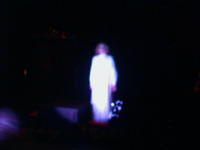
One of my students had a near-fatal motorcycle accident two years ago late at night. He had just driven by a dark temple compound, which is sometimes feared like graveyards are in the west. Temples are where bodies are burned and ashes are buried into crypts in the compound walls; so spirits are thought to linger about the area. My student friend tells me that just after he passed the temple compound, someone glancing his way saw a lady dressed in white sitting behind him on the motobike. The apparition matched the description of a "Pob" ghost--a strikingly beautiful lady who glides about in a mysterious long white dress. However, she is only a "head." Inside the dress are only bare internal organs, not enclosed by a body. She's considered to be a very dangerous and malevolent spirit. Hence, the explanation for his accident. (By the way, at 80 miles per hour, and drunk, he hit a dead dog lying in the road, which sent him out of control. Another possible explanation for the accident.)
A few months ago, one of our younger professors who just won a Fullbright Scholarship to study in the USA for three years, came into my office late at night, as he was preparing to leave.

"Staying late tonight?" he asked with obvious consternation.

"Of course, probably until about 11pm or midnight. Why?"

"Aren't you afraid to stay by yourself?"

"Not really. Should I be?" I thought maybe he knew of some prowling murderer loose on campus.

"What about ghosts?"

I was taken aback. I didn't really expect that comment from someone who had just gotten his master's degree from one of Bangkok's more progressive universities. But my teacher-friend was Isan to the core, which included a solid belief in malevalent spirits--which especially like to plague people who remain alone in big empty buildings.

His wide eyes and sincere concern actually rattled me just a bit.

So that same night, after shutting out all the lights, and powering down the noisy air conditioners, things seemed unnervingly quiet. Then, wandering through a cavernous dark room to the distant door on the far wall, I was just a little more alert to strange sounds and fleeting shadows. What is that white thing in the far corner? A lady in white? No, just the faculty refrigerator in the pantry area.

Never afraid of ghosts in my life, and now I start this in my mid-50's? Get a grip!

A
lmost every night you can count on the TV to dramatize one or two ghost stories in a thriller. Although it scares them, the Thai cannot help watching these, the way morbid onlookers are drawn to the scene of an accident. Every Thai child is told the story of Nang Nak (you can read a brief description of it at www.thailandlife.com/nangnak01.html )

The Thai have many categories and types of ghosts and every Thai person knows all the "species" by name. Thus, I share with you a great article which spells it out in ghoulish detail. I'm gradually learning these names, because it's so much a part of daily conversation!

Picture from a book on Thai ghost stories.


***************************

A Guide To Thailand's Ghosts and Spirits


The Thai spirit world is populated by a plethora of ghosts, ghouls and demons - some good, some harmful, and some openly dangerous. Among the most interesting are:

Phi Peta - A hungry ghost. Everyone who is preoccupied with material attachments to the exclusion of the spiritual will be reborn as a Peta, having a giant belly and an mouth as small as the eye of a needle. Peta may sometimes be heard whistling at night, looking for people to make merit for them. This ghost is relatively harmless.

Phi Am - A ghost which sits on the chest or liver of sleepers, causing discomfort. It can be harmful.

Phi Chamob - A ghost which haunts the place where a woman has died in the jungle. This spirit does not do any harm.

Phi Ha - The spirit of a woman who has died in childbirth. This ghost is considered to be very violent.

Phi Krahang - This ghost appears as a man with feathers and a tail like a bird. It eats filth and glows at night. An unpleasant and frightening spirit.

Phi Krasy - This ghost lives inside a witch and leaves her body during sleep by way of the mouth. The Krasy is the colour of fire, has a head the size of an electric light bulb and a half-metre long bluish tail. A Krasy ghost likes dirt and does not generally harm human beings, although when it consumes entrails (hardly surprisingly) it can cause death. Krasy witches have a sleepy appearance during the day. Their eyes don't blink and they can never look anybody in the face. Also, they don't cast any reflection in the mirror. Before Krasy witches can die, they have to find somebody who will inherit the Krasy by consuming some of the old witch's spittle.

Phi Lok - A ghost which haunts various localities. It frightens and misleads people, and can be seen as well as felt.

Phi Phrai - The spirit of a woman who has died in childbirth and whose body has been used to make phi thai hong lotion. A sorcerer must hold a candle under the corpse's chin, and from the resultant melted oil essences are manufactured which drive men mad and attract women.

Phi Tai Ha - The spirit of a woman who has died of malaria. The ghost will also spread this disease.

Phi Thuk Khun - The substance of a living person which has to be sent out on astral journeys every week, or harm will come to its owner,

Phi Khamod - A spirit in the shape of a red star which, like a Will o' the Wisp, misleads wanderers.

Phi Nang Tani - A female tree spirit which is essentially beneficent and may fill the alms bowls of itinerant monks.

Phi Pa - A forest spirit. Hunters may leave a piece of the foot, lip, tongue or eyelid of a killed animal to show respect to this spirit.

Phi Poang Khang - A spirit in the shape of a black monkey which likes to suck the big toe of people sleeping in the jungle. It is said to live near salt licks.

Phi Ka - These spirits are inherited through women and can be contagious. The Ka, if not properly treated (with raw eggs) will attack and possibly possess people without the owner's knowledge. Perhaps understandably, ordinary people are said to be reluctant to marry into Ka clans!

Phi Hai - Hungry, amoral spirits associated with places where people have died an unnatural or violent death. Phi Hai are easily offended, and take every opportunity to possess people. Normally, they can be induced to leave their victim if suitable offerings are made, but on occasions an exorcist has to drive them out. In such cases, when incantations and lustral water prove insufficient, a whip may need to be employed.

Phi Pob - A malicious and very dangerous spirit which manifests itself as a beautiful woman. Phi Pob float through the air because they have no legs or lower body. They generally appear as a length of internal organs and intestines suspended from a strikingly lovely face - therefore, beware beautiful women gliding mysteriously by in long dresses! This type of ghost is probably more feared than any other species in Thailand.

C
learly, there can be no doubt that belief in ghosts and spirits remains widespread throughout Thailand....Chinese "bouncing" ghosts have long been a staple of Thai television and children's fantasy. Muslim ghosts have appeared which can be driven off by flourishing a piece of pork (preferably a pig's head) at them, and even vampires have made the long journey from Transylvania to Thailand. In this age of mass communication and international tourism, ghosts too - or so it would seem - have become world travellers!

Text of above article, copyright © Andrew Forbes / CPA 2003. Found at www.cpamedia.com.